5 min read Field note for CluTerm
The Fix That Read Its Own Echo
Putting my own agent on a pair of smart glasses: what the community had already worked out, what only showed up on real hardware, and a repair loop that kept the lens dark by repairing it.
I wanted to hold a button on a pair of glasses, say a sentence, and have the agent on my own machine answer in front of my eye. No vendor cloud in the loop, no phone app I did not write.
The glasses are Even Realities’ G2: a green 576×288 display in the lens, microphones, a touch strip on each temple, no speaker. This is what it took to make them a client of CluTerm, and first, whose work it stands on.
Whose reverse engineering this is
Not mine, mostly. The G2’s Bluetooth protocol had already been worked out in public by other people, and my implementation is a port and extension of theirs:
- MentraOS (MIT) for the framing, the checksum, the event types and the display constraints.
- OpenEvenSdk (MIT) for the connection sequence, text pages and image tiles.
- g2-kit-unofficial (MIT) for the fields of the glasses’ own list widget.
- men-g2-ble-gateway (MIT), a Python port of the first.
What I added is narrower and, I think, still worth writing down: the things those sources did not say, which only appear when a real pair is on a bench answering a real program. Three of them cost me the most.
Two arms, and the microphone is in the left one
The G2 is not one Bluetooth device. Each arm is its own peripheral, and they do different jobs.
My first voice build connected, armed the microphone, got a cheerful acknowledgement, and reported “no speech heard” every single time. The audio was fine. It was arriving on the left arm, and I was listening to the right. A four-second hold produced 75 packets, every one of them on the side I had not subscribed to.
The lesson I took was not about arms. It was that for an hour, a write nobody received had looked exactly like a write that landed. Silent success is the most expensive kind of failure, so those writes are loud now.
The display has the opposite quirk. Pages drawn on the right arm are mirrored to the left by the glasses themselves. The built-in widgets are not: write the date to one arm and you get two lenses showing two different days.
The repair that caused the outage
After a conversation turn, the lens would sometimes go dark and stay dark until the link was dropped and remade. The glasses had quietly discarded my page, and every update after that was refused with the same error code. My compositor had a line that amounted to “ignore that event.”
So I wrote the obvious fix: when the page is lost, create it again.
It made things worse. One session logged 576 of those refusals and drew nothing at all.
Here is what was happening. After a page is created, the glasses need a moment before they will accept text on it. During that moment they refuse the update, with the same error they use for “that page does not exist.” My repair created the page and repainted in the same tick. The repaint was refused. The repair read that refusal as proof the page had died, created it again, repainted again, was refused again. A closed loop, running as fast as the radio allowed, each pass undoing the one before.
The fix read its own echo and took it for the disease.
What ended it was a 700 millisecond settle window after every create, during which a refusal means nothing, plus a backoff from five seconds to a minute if the page really is gone. Refusals went from 576 to zero.
I keep this one because the shape is everywhere. A health check that restarts a service before it has finished starting. A retry that triggers the rate limit it is retrying past. Any controller that cannot tell its own disturbance from the fault it is correcting will oscillate, and it will look like diligence in the logs.
What a turn feels like
On the bench the glasses talk to a Raspberry Pi running the ordinary CluTerm agent. Hold the temple, speak: the words appear on the lens as you say them, transcribed on the Pi. Let go, and the agent’s answer streams onto the lens, and is spoken through the Pi’s headphone jack, since the glasses cannot make sound.
I measured a week of my own use, 55 turns:
I have not re-measured since the fix, so I am not going to tell you what the second bar is now.
Why there are two versions
Talking straight to the glasses over Bluetooth works with no phone and no account, and it is unofficial. One firmware update can end it.
So there is a second client on the vendor’s own app platform: a small web app that runs inside the Even phone app, with CluTerm’s client compiled from Rust to WebAssembly so the encryption still ends on a device I own. That platform is documented and supported, and it is deliberately narrow. No Bluetooth access, no sound out, no notifications. Each track covers the other’s weakness.
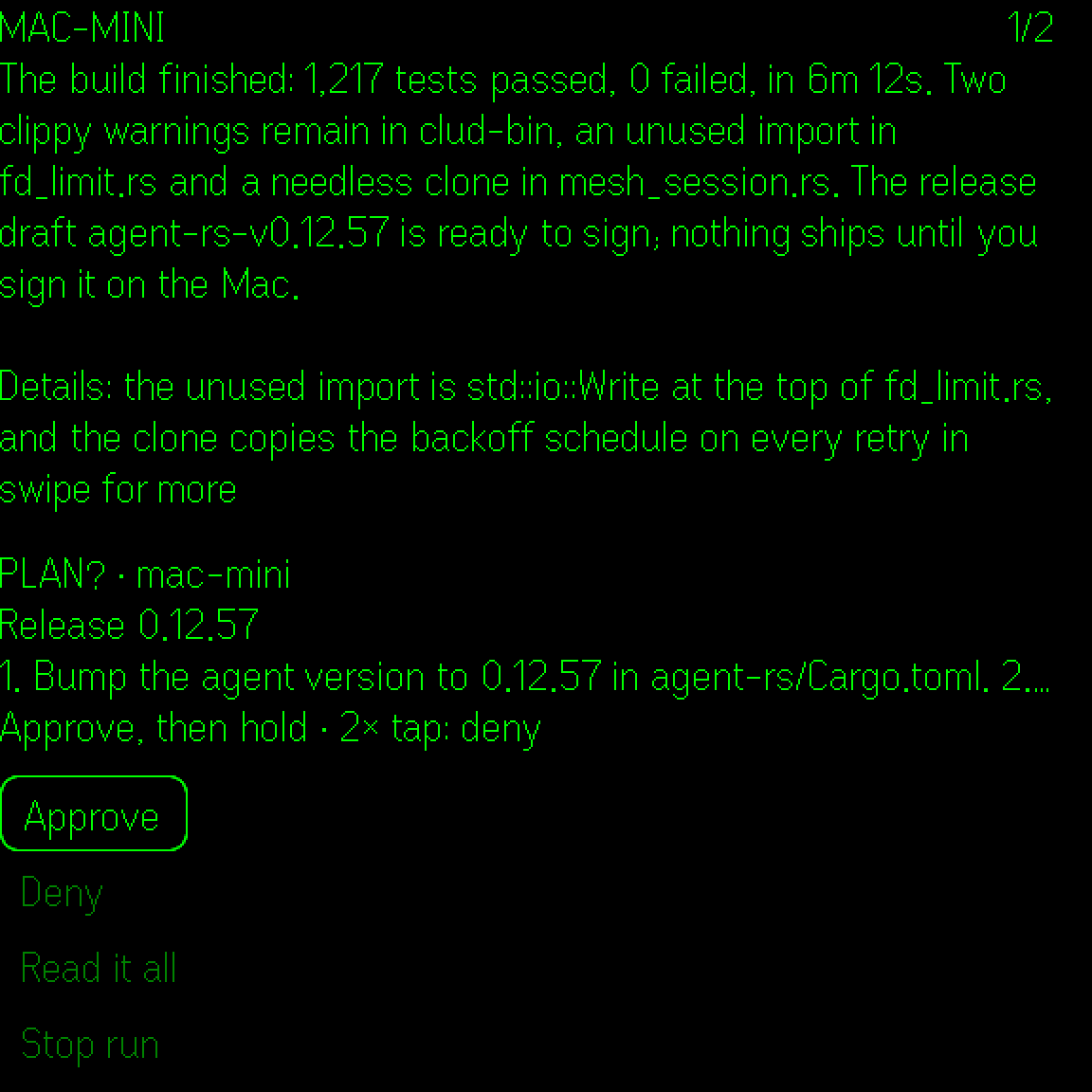
Approving things with one finger
A device with no keyboard is a risky thing to hand a “yes” button, so by default the glasses can only read. When I do let them approve a plan, three rules hold.
The approval is bound to what was shown. Each card carries a fingerprint of its exact contents; the lens recomputes it over what actually arrived and only offers Approve if they match. A card that was cut off in transit cannot be approved at all.
A tap is not enough. You select Approve, then press and hold for over a second. A double tap denies. Doing nothing denies, after five minutes.
And a tap is never turned into words. Anything the agent is asked comes from the wearer’s voice. A tap can choose between the options on a card. It cannot compose an instruction.
What I am not claiming
I did not reverse engineer these glasses; I built on people who did, and found the edges they had not written down. The Raspberry Pi is on a desk, not in a pocket. The app is in private testing, not publicly listed. And “under a second to first words” is a target on a whiteboard.
What I have is a lens that answers, a microphone I know the address of, and a repair loop that has learned to wait before it believes itself.